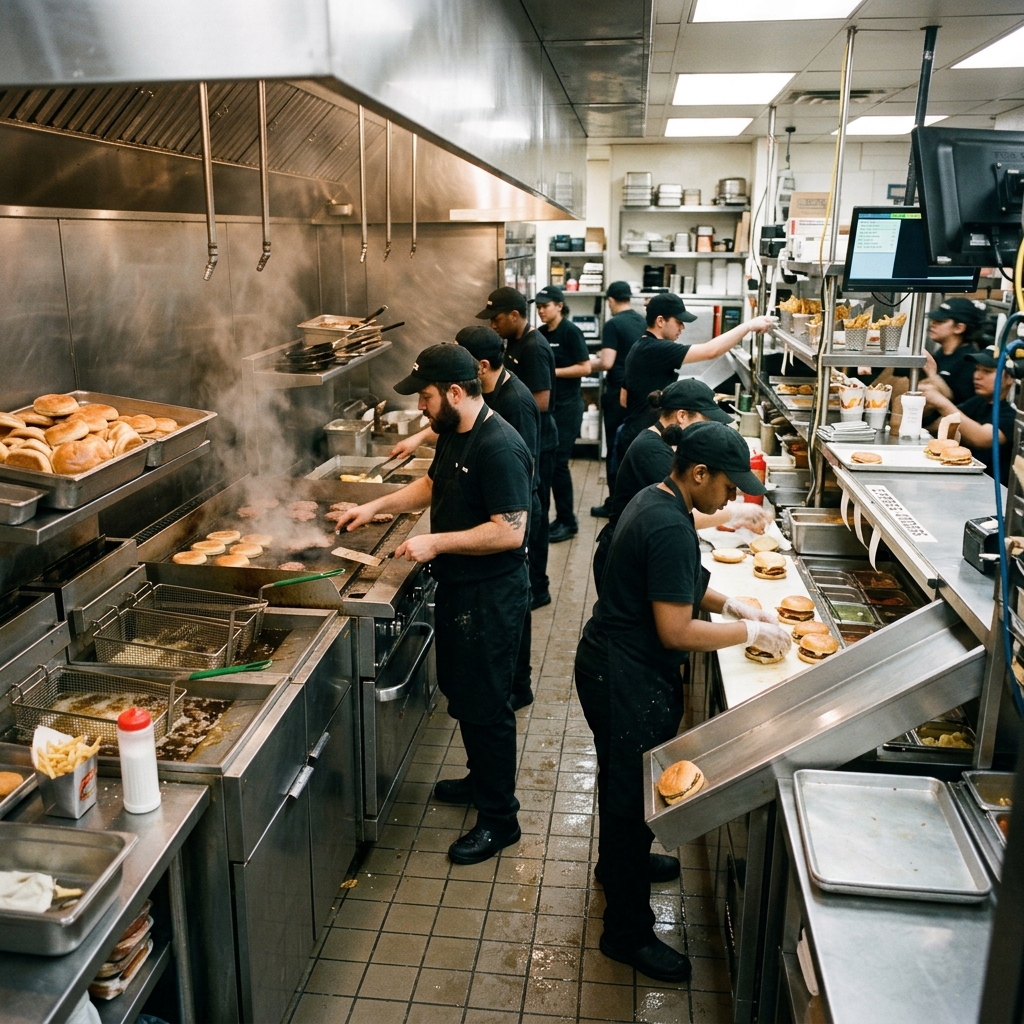
It has been over two years since California’s AB 1228 implemented a $20 minimum wage for fast-food workers, and the dust has finally settled on the unit economics. Forget the macroeconomic academic studies debating aggregate employment numbers; if you want to understand the real impact, talk to an El Pollo Loco or Jack in the Box franchisee in Los Angeles. The reality on the ground is a brutal, daily fight for basis points. Operators are no longer managing growth; they are managing survival through ruthless, microscopic operational efficiency.

The immediate levers were pulled back in 2024: menu prices jumped by 8% to 12% at many locations. However, you can only squeeze the consumer so much before traffic collapses. In 2026, the strategy has shifted entirely to labor suppression. Franchisees are actively cutting total employee hours and completely eliminating overtime. To maintain throughput with fewer hands on the line, operators are being forced to aggressively deploy capital into kitchen automation. We are seeing a massive acceleration in the adoption of automated fryers and self-ordering kiosks—not as a luxury tech upgrade, but as the only mathematical way to keep the doors open.
“The margin of error in a California quick-service kitchen is now exactly zero,” states David Reynolds, a multi-unit franchisee operator. “When your baseline labor cost spikes that violently, you have to strip every ounce of wasted movement out of the prep line. If a menu item takes an extra 15 seconds to assemble and doesn’t pull its weight in margin, we cut it. We are utilizing robotics for the fry station simply because we cannot afford to pay a human twenty dollars an hour to stand in front of hot oil.”

California is serving as the ultimate stress test for the American fast-food model. The operators who survive 2026 will be the ones who successfully treated their kitchens like lean manufacturing plants, proving that in a high-wage environment, operational grit is the only currency that matters.